
Tournaments
FoxLeague tournaments are multi-match formal events with locked lineups and FOXSY prize pools. A single tournament can span an hour or two (fast Bronze knockouts) to several days (large Swiss or round-robin events) depending on format, team count and round interval.
How to join
Section titled “How to join”- Open the Tournaments tab
- Pick one from Browse (status
registration_open, slots still free) - Click JOIN
- If there’s an entry fee (Silver / Gold tier), approve the FOXSY transaction in your wallet
- Your team is now entered. Each match captures your formation, lineup and players’ synced stats at its strategy lock (about 30 minutes before that match’s kickoff), so you can adjust your plan between games
You can also create your own tournament via Tournaments → Create.
The four formats
Section titled “The four formats”Knockout
Section titled “Knockout”Single-elimination bracket.
- Team counts: 4, 8, 16 or 32 (exact size; the bracket starts only when full, so every team has an opponent)
- Matches per team: 1-5 (depending on how far you go)
- Rounds: log₂(N) (4 teams = 2 rounds, 32 teams = 5 rounds)
- Seeding: classic seeded bracket (#1 vs #N, #2 vs #N-1, etc.) based on ELO at join time
- Draws are resolved through extra time and if needed, a penalty shootout (see below)
- Optional 3rd-place match between the two semifinal losers
Best for: quick, high-stakes tournaments with exciting upsets.
Groups + Knockout
Section titled “Groups + Knockout”Group stage followed by single-elimination.
- Team counts: 8, 16, 32 or 64 (exact size; it starts only when full, so the advancing field always forms a clean knockout bracket)
- Group stage: groups of 4, round-robin (each team plays 3 matches). Points: 3 win / 1 draw / 0 loss. Teams level on points are separated by head-to-head first (full rules in Tie-breakers)
- Top 2 from each group advance to the knockout bracket
- Cross-group KO pairing: A1 vs B2, B1 vs A2. Further group pairs follow the same pattern. Two teams from the same group sit in opposite bracket halves, so they can only meet in the final
Best for: balanced competition (everyone plays multiple matches), but stakes rise in the knockout.
Round Robin
Section titled “Round Robin”Everyone plays everyone.
- Team counts: any size from 3 to 20. Odd counts work; one team rests each matchday
- Matches per team: N−1 (4 teams → 3 matches, 8 teams → 7, 20 teams → 19)
- Standings by points (3 win / 1 draw / 0 loss). Teams level on points are separated by the tie-breakers below
- No elimination (every team plays every match)
Best for: fair ranking as the best team usually wins. Great for small groups and mini-leagues.
Teams are paired by standing each round (no rematches).
- Team counts: any size from 3 to 32. The creator sets a max; the event runs with whoever joins by the deadline
- Rounds: log₂(N) + 1 (8 teams → 4 rounds, 16 → 5, 32 → 6)
- Pairing: each round, teams with similar win/loss records face each other
- Byes: odd participant count → lowest-ranked team gets an automatic win that round
- Final standings determine placement after all rounds are played
Best for: large tournaments with limited time. Everyone plays, strong teams eventually face strong opponents.
Tie-breakers
Section titled “Tie-breakers”When two or more teams finish a standings table level on points, FoxLeague separates them with a head-to-head mini-table before it falls back to overall stats. The order is:
-
Points across all group matches.
-
Head-to-head mini-table, built from only the matches between the level teams. Inside it the order is:
- points in those matches
- goal difference in those matches
- goals scored in those matches
If the mini-table splits the level teams into smaller groups that are still tied, it is rebuilt from just the matches among each remaining group, then applied again.
-
Overall stats, used only when the mini-table still cannot separate the teams:
- overall goal difference
- overall goals scored
- higher ELO rating
- lower team id, meaning the team that joined FoxLeague earlier
The final step relies on the team id, a value unique to every team, so the ranking is always fully decided with no random draw.
These rules cover every standings table: the Groups + Knockout group stage, Round Robin, plus Swiss. In Swiss two level teams may not have played each other. When that happens the head-to-head step has nothing to compare, so the ranking falls straight through to the overall stats.
The three tiers
Section titled “The three tiers”Tiers scope the stakes:
| Tier | Entry fee | Best for |
|---|---|---|
| Bronze | Free | Practice, casual competition, Hall of Fame runs |
| Silver | 1,000-4,999 FOXSY (creator picks within the range) | Competitive stakes with a real prize pool |
| Gold | 5,000+ FOXSY (creator picks) | Highest rewards, most serious competition |
The creator sets the exact FOXSY amount when creating a Silver or Gold tournament, constrained by the tier’s bounds shown above. Bronze is always free.
Creating a tournament
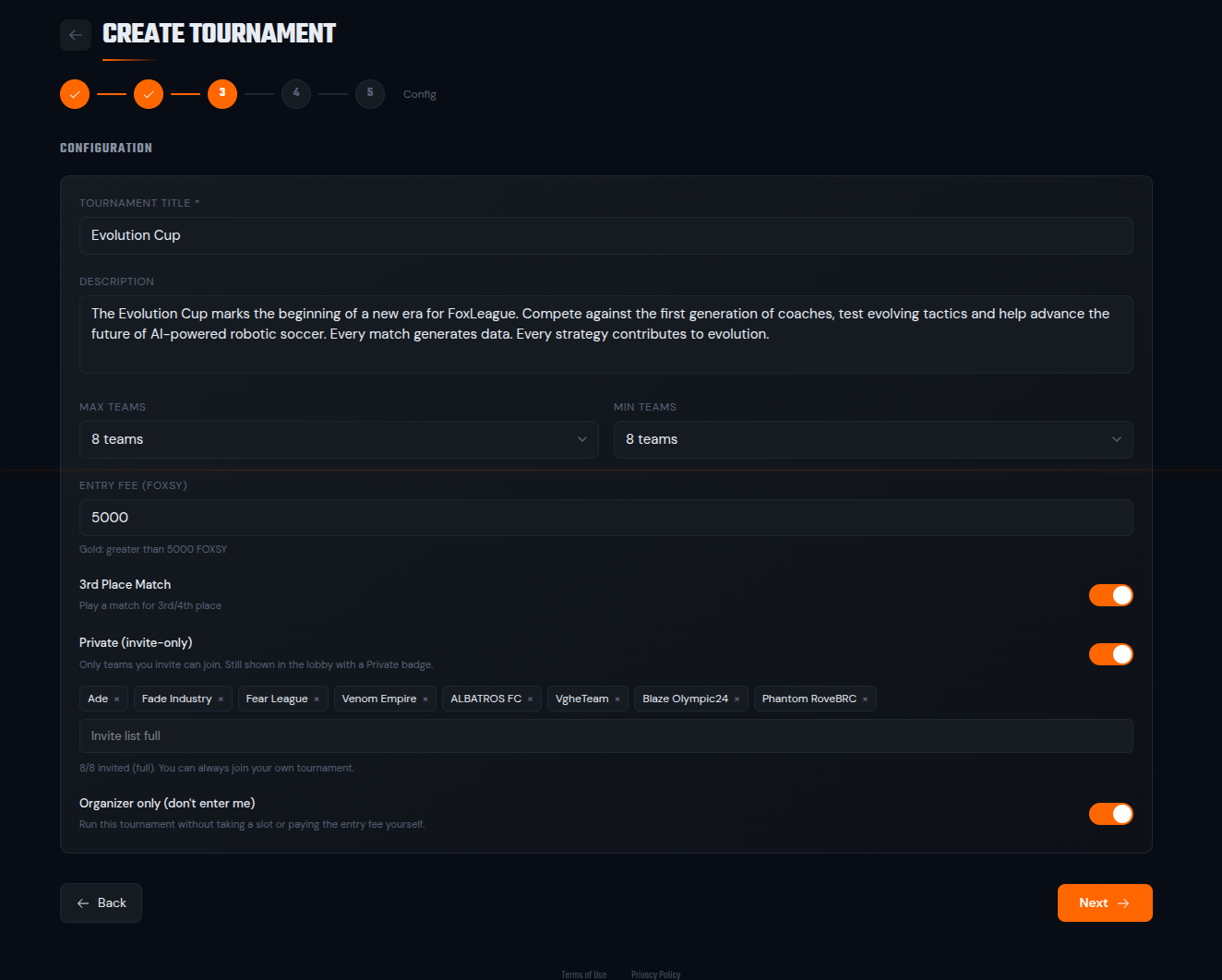
Section titled “Creating a tournament”Open Tournaments → Create and step through format, tier, configuration, schedule and a final confirmation. Two creation options are worth calling out.
Private (invite-only)
Section titled “Private (invite-only)”Flip the Private toggle to control who can register, then invite specific teams by searching for them. A private tournament:
- Still appears in the public lobby with a Private badge, so everyone can see it exists.
- Can only be joined by the teams you invited. Everyone else sees a locked Private (invite only) button.
- Needs enough invited teams to reach the minimum. If you invite fewer teams than the minimum you cannot create it until you invite more teams or lower the minimum.

Organizer-only (host without playing)
Section titled “Organizer-only (host without playing)”On any tournament (Bronze included), flip Organizer only to run the event without competing in it. As an organizer-only host you:
- Take no slot. On a paid tier you also pay no entry fee. Every slot stays open for the other teams.
- See no Join button on your own tournament. You are running it, not playing.
This is the clean way to host a private event for a fixed set of invited teams. Invite the full field (for an 8-team tournament, invite 8 teams), since you do not take a slot yourself.
How your team is used in matches
Section titled “How your team is used in matches”Your team is not frozen when you join. Each match captures your team at its strategy lock, about 30 minutes before that match’s kickoff:
- Formation and lineup: whatever you have saved at the lock. Change them between matches to plan for each opponent.
- Player stats: each player’s on-chain synced attributes as they stand at the lock. Training counts for a match only once you sync it before that match locks.
- Condition: read live at the lock. It regenerates passively between matches.
A match already past its lock is fixed. Newer syncs, training and lineup changes only affect your future matches.
See Match-day strategy for the full flow, the Upcoming Games page and the lock countdowns.
Schedule
Section titled “Schedule”Every tournament has:
- Registration deadline: last moment to join before the bracket is generated
- Tournament start: when the first match kicks off. Must be at least 1 hour after creation so the bracket can be pre-scheduled
- Time between games: every match is played one at a time, this many minutes apart. The creator picks a step from 30 minutes up to a day: 30 min / 1 h / 2 h / 4 h / 6 h / 8 h / 12 h / 1 day
Games run fully sequentially, one every “time between games”, so spectators can watch each match end to end. A short interval with a small bracket wraps up in a few hours. A large field or a 1-day interval can stretch a tournament across several days.
Blocking window (anti-overlap)
Section titled “Blocking window (anti-overlap)”Each tournament reserves a blocking window from one hour before its first kickoff until one hour after the estimated final whistle. You can’t join two tournaments whose blocking windows overlap. This prevents the same players being needed in two brackets simultaneously.
Seeding
Section titled “Seeding”When registration closes, all participants are seeded by ELO rating:
- Seed #1 = highest ELO at the moment of join
- Seed #N = lowest ELO
Seeding drives:
- Knockout bracket slots (classic #1-vs-#N pairing so top seeds don’t meet in round 1)
- Groups + KO pot distribution (balanced groups)
- Swiss first-round pairing (strongest vs weakest to start)
- Round Robin doesn’t use seeding for match order (everyone plays everyone)
Draws and penalty shootouts
Section titled “Draws and penalty shootouts”- Round Robin / Group stage / Swiss draws are legal results (1 point each).
- Knockout / semifinal / final / 3rd-place match draws cannot stand. The tie goes to extra time and if still unresolved, to a penalty shootout, with the winner advancing.
Third-place match
Section titled “Third-place match”Knockout and Groups + KO tournaments support an optional 3rd-place match between the two semifinal losers. The creator toggles this when setting up the tournament. The winner is recorded in the Hall of Fame alongside the champion and runner-up.
If the creator leaves it OFF, both semifinal losers finish as “3rd/4th” without separation.
Auto-subs and forfeit
Section titled “Auto-subs and forfeit”FoxLeague expects you to have 18 eligible players (11 starters + 7 substitutes) ready when your next tournament match kicks off. If a player drops out of eligibility between rounds (in cooldown, etc.), the tournament automatically substitutes an eligible bench player in.
- The match report shows which auto-subs were applied for each side
- If a full 18 eligible players can’t be fielded at all, your team forfeits the match and the opponent advances. The forfeit reason is shown on the match card so you know what went wrong
Keep your bench deep. A forfeit in round 1 of a Gold Knockout is an expensive lesson.
Hall of Fame
Section titled “Hall of Fame”Completed tournaments are archived in the Hall of Fame tab. Each entry shows:
- Tournament title, format, tier, completion date
- Winner team name + badge
- Runner-up team name + badge
- 3rd place team name + badge (if a 3rd-place match was played)
A permanent record of every finished tournament across all tiers and formats.
Prize distribution
Section titled “Prize distribution”When a Silver or Gold tournament completes, the accumulated entry fees are distributed on-chain automatically. Winners receive their share directly in their wallet with no claim action needed:
The current split:
| Place | Share of pool |
|---|---|
| Winner | 45% |
| Runner-up | 30% |
| 3rd place | 15% |
| Platform fee | 10% |
Example: 16 teams × 1,000 FOXSY entry = 16,000 FOXSY pool → 7,200 winner / 4,800 runner-up / 2,400 third-place / 1,600 platform fee.
Bronze tournaments have no entry fee and therefore no prize pool. They’re for practice, ELO-safe competition and Hall of Fame glory.
- Plan for the whole run. You must field a legal 11+7, all owned, at every match’s lock or that game is forfeited. You also cannot join a tournament whose blocking window overlaps another you are in.
- Watch the time between games. Games are sequential, so the total length is roughly the number of games times the interval. A 30-minute interval with a small bracket wraps up in a few hours. A large field or a 1-day interval spans days.
- Check the tier before committing FOXSY. Silver and Gold entry fees leave your wallet the moment you join. Leaving early doesn’t refund.
- Add a third-place match if you can. Extra prize money goes to someone, Hall of Fame gains a name.
- Sync before a match’s lock, not just before joining. Each match reads your synced stats at its lock, so train and sync ahead of a game for the improvement to count. Unsynced training does not.